913-second window · 3 observations · Measured Oct 7, 2026, 5:12 PM UTC · Provider: go_recent_snapshot_v2
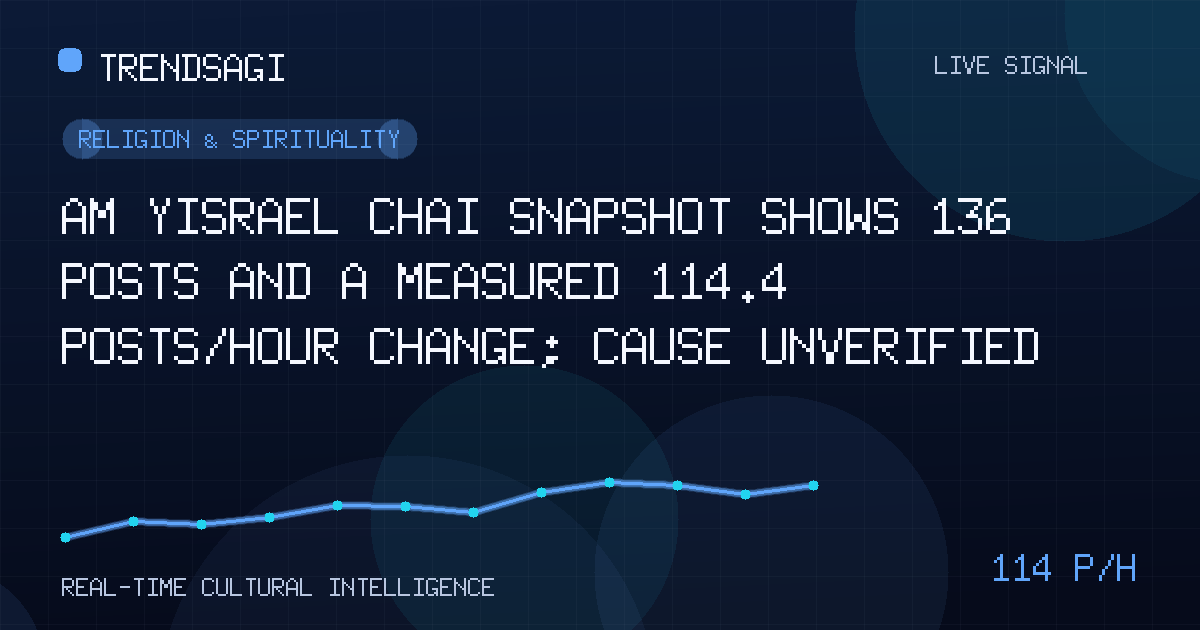
Am Yisrael Chai snapshot shows 136 posts and a measured 114.4 posts/hour change; cause unverified
Am Yisrael Chai recorded 136 posts and a measured 114.4 posts/hour change; the cause is unverified, with persistence and origin still to check.
Automated briefing. Generated from stored signal measurements and source-backed research; it is not manually reviewed. Read the methodology and limitations.
Metrics in this briefing are a snapshot associated with its publication date and may not reflect current conditions.
What changed
Am Yisrael Chai showed a concentrated increase in posting, with 136 posts in the latest snapshot and a measured snapshot rate of 114.4 posts/hour. The record establishes a short-window change in posting activity, but not why the topic moved. No specific public catalyst has been verified, so the signal should not be presented as a reaction to a named event.
The rate was measured over an exact 913-second window using 3 stored observations at 2026-10-07T17:12:02Z. It is a historical snapshot rate, not a live or current rate, forecast, reach measure, engagement count, or unique-person count. The 136 posts are a separate snapshot volume; they should not be converted into a rate or treated as a count of people.
| Observation time | Measured snapshot rate | Snapshot volume |
|---|---|---|
| 2026-10-07T17:12:02Z | 114.4 posts/hour | 136 posts |
What the signal can establish
The defensible conclusion is narrow: the supplied series registered an increase at 114.4 posts/hour during the defined window. That is enough to prioritize review and establish a point for comparison. It is not enough to say the topic is unusually active relative to its own history, because no longer baseline is available.
- What is supported: the rate, timestamp, short window, and snapshot volume are descriptive facts about this observation.
- What is not supported: motive, sentiment, organic versus automated activity, geography, platform, reach, or causal linkage to an outside event.
- What can be done: editors can preserve this observation, collect comparable windows, and test whether the burst persists, repeats, or disappears.
The strongest supported statement is that posting accelerated during this short observation window; the unsupported leap would be to assign a cause before a timestamped catalyst is verified.
This distinction matters because a short spike can be useful without being mature enough for a trend narrative. The right posture is to report the measured movement, label the cause unknown, and state what evidence would change that assessment.
Why this topic may be moving
No verified public context was established for this snapshot. Several mechanisms could create the pattern, but each needs evidence rather than assumption:
- Calendar context: Check whether a commemoration, observance, anniversary, or scheduled event connects to the observation date. None is verified here, so date adjacency cannot be used as the explanation.
- Religious or communal expression: The Religion & Spirituality classification makes prayer, solidarity, mourning, and identity affirmation plausible content types. It does not show which, if any, are present.
- Media recirculation: A clip, performance, image, or repeated line could produce a copy-forward burst. The evidence does not identify an originating item.
- News spillover: A broader event could drive people to the phrase as a concise expression of reaction. Until a credible report or first-party statement connects that event to the timing, this remains only a hypothesis.
- Distribution artifact: Repeated wording, media, or account behavior may inflate apparent activity without adding distinct perspectives. Duplication and coordination have not been tested.
These are hypotheses, not ranked findings. Without source-level verification, attributing the spike to a ceremony, media release, political reaction, or coordinated campaign would exceed the evidence.
Why it matters
- Community and religious leaders should determine whether the conversation is calling for clarification, pastoral support, gathering information, or moderation. They should not infer those needs from volume alone.
- Journalists need the earliest posts and any cited source before turning the spike into a narrative about public sentiment. A phrase used repeatedly may carry different intentions in different communities.
- Editors and trend desks should label the metric correctly and resist causal language until a catalyst is verified. The useful finding is the change; the unverified part is the explanation.
- Platform and trust teams can test for repeated media, automated reposting, or coordinated behavior. The topic itself is not evidence that any of those conditions exist.
- General readers can use the briefing as an alert, not a verdict: posting accelerated, but consensus, causation, and participation remain unresolved.
What to watch next
The next checks should turn an unexplained burst into a testable account:
- Test persistence. Collect additional observations over comparable 913-second windows and compare measured change rather than raw volume. Continued elevation would support sustained attention; a quick return to the prior pattern would favor a temporary burst.
- Find the origin. Work backward from the earliest substantive items. Preserve exact timestamps, quoted text, media references, account history, and whether each item is original, a quote-post, or a duplicate.
- Verify a catalyst. Check credible reporting and first-party public statements for an event tied to the observation period. A candidate cause should be timestamped before the burst, specifically connected to the phrase, and independently corroborated; mere repetition is not verification.
- Classify the posts. Code for prayer, solidarity, mourning, celebration, political commentary, media sharing, and question-asking. Analyze language and geography only if those fields were actually collected; do not infer either from the topic label.
- Audit repetition. Group exact and near-duplicate text, repeated media, and near-simultaneous account patterns. Report how much of the snapshot consists of distinct original contributions versus redistribution.
- Look for confirming signals. A verified public statement, concrete event information, new independently written posts, or resource-sharing would strengthen the interpretation. A cluster dominated by copied text would weaken it.
Methodology and limitations
The measured rate is descriptive and window-dependent. With only 3 stored observations, a tightly clustered set of posts can materially shape the result. The record does not provide a longer baseline, sampling method, platform scope, or collection interval, so it cannot establish whether 114.4 posts/hour is high for this topic or likely to continue.
The snapshot volume and change rate answer different questions. The former describes posts attached to the latest observation; the latter describes the measured rate of change across the defined window. Neither reveals unique authors, sentiment, authenticity, engagement, or causation.
Stronger follow-up should retain the raw post text, timestamps, media references, permissible account identifiers, and classification labels. That evidence would allow independent reproduction, duplication testing, comparison with adjacent topics, and checks on whether public context preceded the activity. Until then, the responsible conclusion remains: the measured posting rate increased, the latest snapshot contained 136 posts, and the cause is unknown.
Track This Topic for New Signals
Set alerts for future velocity or sentiment changes around this topic.
Explore Tracking PlansAbout TrendsAGI research
TrendsAGI's automated research pipeline publishes dated signal snapshots, methodology notes, and practical workflows for teams evaluating cultural momentum. Read how signals are scoped, scored, and limited in our research methodology.