806-second window · 3 observations · Measured Sep 30, 2026, 1:53 PM UTC · Provider: go_recent_snapshot_v2
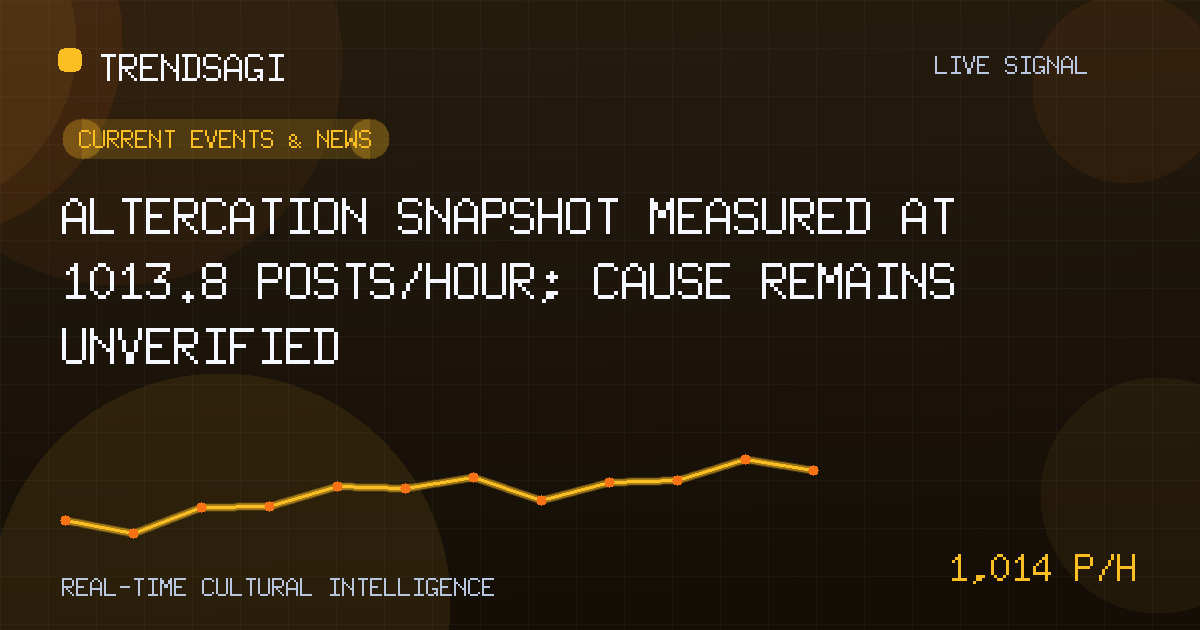
Altercation snapshot measured at 1013.8 posts/hour; cause remains unverified
Altercation recorded 489 posts and a measured 1013.8 posts/hour snapshot rate; the cause is unverified, so event-level checks remain necessary.
Automated briefing. Generated from stored signal measurements and source-backed research; it is not manually reviewed. Read the methodology and limitations.
Metrics in this briefing are a snapshot associated with its publication date and may not reflect current conditions.
What changed
The monitored topic “Altercation” shows a concentrated burst of posting activity, but the available evidence does not tie that burst to a verified news event. The latest stored snapshot contains 489 posts. For editors and readers, this is a signal to investigate, not confirmation that a single confrontation—or a broader public-safety issue—is driving wider attention.
The measured change is 1013.8 posts/hour over an exact 806-second window using 3 stored observations, measured at 2026-09-30T13:53:17Z. This is a measured snapshot rate, not a live/current rate, forecast, reach estimate, engagement total, or unique-person count. The 489 figure is snapshot volume only; it is not another rate and does not establish the number of distinct incidents or people.
| Observation time | 2026-09-30T13:53:17Z |
|---|---|
| Measured snapshot rate | 1013.8 posts/hour |
| Latest snapshot volume | 489 posts |
Why this topic may be moving
No verified public context establishes a specific cause, so the trigger should be treated as unclear. The label is also broad: posts filed under it could refer to unrelated fights, disputes, police encounters, workplace conflicts, court-linked exchanges, or something else. Without text-level review, a shared keyword cannot tell those situations apart.
Several mechanisms could explain the measured movement. One widely shared incident may have generated repeated posts; several unrelated incidents may have been compressed into the same label; captions or transcripts may have caused the term to spread; or recommendation and reposting systems may have amplified already popular material. None of those explanations is confirmed by the stored signal. The decisive test is whether sampled posts converge on the same named event, place, time, and participants rather than merely sharing a generic word.
A high-volume keyword feed can rise because one event is repeatedly discussed or because several unrelated events are compressed under one label. Until event-level records align, volume establishes attention to a term, not a shared cause.
That distinction matters because aggregation can create confidence without evidence. A fast rise in matching posts can look like consensus, yet it may reflect repetition by a limited set of accounts, a platform-wide keyword association, or several stories being mistaken for one. A reliable briefing must separate observed posting activity from verified meaning.
What the signal can establish
- Timing and intensity: The signal establishes a measured 1013.8 posts/hour snapshot rate tied to an exact 806-second window and a stated observation time.
- Content volume: The 489 posts show the size of the latest matching snapshot, but they do not reveal how many people posted or how many real-world events are represented.
- No settled cause: The stored information does not identify a triggering incident, location, organization, or public-safety condition with sufficient confidence.
- A verification priority: The increase is large enough within the monitored signal to justify event-level checking, but not enough to support a claim about public impact or consensus.
Why it matters
For newsrooms and communications teams, premature attribution could spread the wrong story. A generic term such as “Altercation” can accidentally combine unrelated local incidents, fictional or dramatized material, older footage, and current reporting. Any summary should wait for matching details before presenting the activity as a unified event.
Public-safety and community-monitoring teams may also need to distinguish a genuine local cluster from keyword noise. The right response depends on verified geography, incident details, and source quality. A high posting rate may indicate a sudden increase in discussion, but it does not by itself show that risk has increased.
For readers and analysts, the episode illustrates the difference between attention and evidence. The signal is useful for deciding what to inspect next; it is not a measure of how common altercations are, how severe they are, or whether the underlying claims are true.
What to watch next
- Inspect the underlying posts: Review a representative sample for named people, locations, dates, source material, and links to the same incident. Determine whether the wording is independent, copied, reposted, or promotional.
- Seek independent corroboration: Check whether verified public reporting or an appropriate official source connects the activity to the same event. Repetition within the feed is not independent confirmation.
- Use a new comparable window: Collect another bounded observation rather than extending the 806-second window. That will show whether the measured burst persists, decays, or changes without presenting this snapshot as a live trend.
- Measure account and text diversity: Compare the number of participating accounts, repeated passages, and reposting patterns. Do not equate many posts with many independent witnesses.
- Test geographic and semantic spread: Separate posts tied to a specific place from broad keyword use. Posts discussing different kinds of conflict should not be combined merely because they share the label.
Concrete watch signals
- Subsequent samples repeatedly identify the same event, location, time, and participants.
- A separate comparable observation shows continued activity, reversal, or another rise.
- Original wording and distinct accounts replace duplicated or highly repetitive material.
- Verified public reporting converges on the same incident and provides enough detail to distinguish it from unrelated “altercations.”
Methodology and limitations
The supplied rate was calculated from 3 stored observations over the exact 806-second window recorded at 2026-09-30T13:53:17Z. The record does not provide a historical baseline, comparison period, geography, platform mix, post text, account totals, engagement data, sentiment, or deduplication method. It therefore cannot establish total conversation size, unique participants, authenticity, severity, public reach, or causation. The measured rate and snapshot answer different questions: the former describes posting velocity within the specified window, while the latter describes the amount of matching content in the latest snapshot. Until verified event-level evidence is available, the reason for the movement remains unclear.
Track This Topic for New Signals
Set alerts for future velocity or sentiment changes around this topic.
Explore Tracking PlansAbout TrendsAGI research
TrendsAGI's automated research pipeline publishes dated signal snapshots, methodology notes, and practical workflows for teams evaluating cultural momentum. Read how signals are scoped, scored, and limited in our research methodology.