15-minute window · 3 observations · Measured Oct 3, 2026, 12:56 AM UTC · Provider: go_recent_snapshot_v2
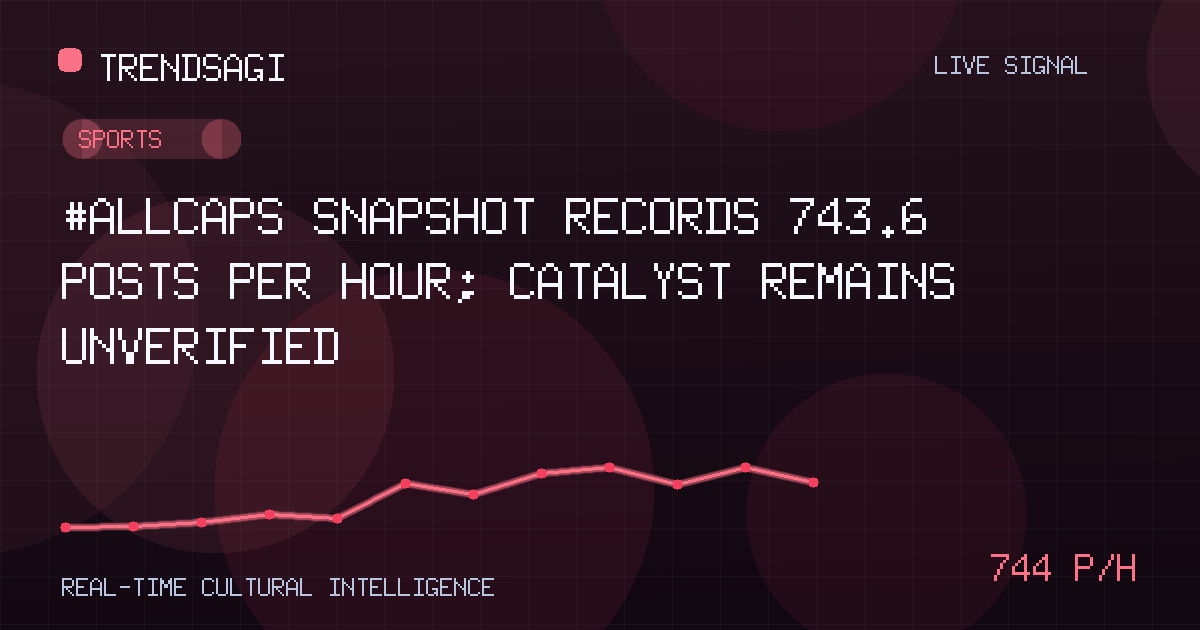
#ALLCAPS snapshot records 743.6 posts per hour; catalyst remains unverified
The latest #ALLCAPS snapshot records 240 posts and a measured 743.6 posts per hour, while the catalyst behind the activity remains unverified.
Automated briefing. Generated from stored signal measurements and source-backed research; it is not manually reviewed. Read the methodology and limitations.
Metrics in this briefing are a snapshot associated with its publication date and may not reflect current conditions.
What changed
At the latest stored observation, #ALLCAPS had a snapshot volume of 240 posts and a measured snapshot rate of 743.6 posts per hour. That rate covers an exact 900-second window based on three stored observations. The direct answer is that the label showed a documented short-window posting signal at 2026-10-03T00:56:36Z, but the cause is unclear and no specific sports event has been verified.
| Observation time | Measured snapshot rate | Latest snapshot volume |
|---|---|---|
| 2026-10-03T00:56:36Z | 743.6 posts/hour | 240 posts |
The 743.6 figure should be read only as a measured snapshot rate, not as a live or current rate, forecast, reach figure, engagement measure, or count of unique people. The 240 posts are a separate snapshot-volume measure. With no earlier baseline in the record, the data also does not prove that posting accelerated relative to normal activity. Sports is the stored category, but a category label is not proof of the underlying catalyst.
Why this topic may be moving
No verified public context available for this briefing connects #ALLCAPS to a confirmed catalyst. The following are testable possibilities rather than findings:
- The label accompanied reaction to a sports event, result, controversy, or announcement, although no specific event has been identified in the available record.
- All-caps wording functioned as a phrase, chant, meme, slogan, or formatting convention that crossed unrelated conversations.
- A promotion, campaign, or coordinated posting effort reused the label.
- Reposting, repetitive text, or account automation concentrated the apparent activity.
- The stored Sports classification was broader than the actual content, or the label was used ambiguously.
These possibilities require different evidence. A named event needs public-source confirmation; automation needs account and content analysis; ambiguous usage requires reading the posts themselves. Volume alone cannot distinguish among them.
Why it matters
The signal is useful as an investigation trigger, not as proof of a broader cultural or sports trend. The rate describes the cadence within one narrow window, while snapshot volume describes how many posts were present at one timestamp. Neither establishes audience size, intensity of interest, or whether the activity was organic.
- Editors and journalists should verify a catalyst before turning the posting rate into a narrative.
- Sports media and community teams should check whether the conversation is genuinely relevant to their sport, audience, or event coverage.
- Trust-and-safety teams should examine repetition, account concentration, and possible coordination before treating the activity as normal.
- Researchers and social analysts should preserve the exact window and counting method so later snapshots can be compared consistently.
A measured posting rate can flag a change in conversation cadence without proving that more people joined, that a specific event happened, or that the activity was organic.
What the signal can and cannot establish
The record supports a limited set of factual conclusions:
- #ALLCAPS had 240 posts in the latest snapshot.
- The supplied measured snapshot rate was 743.6 posts per hour for an exact 900-second window.
- That rate was calculated from three stored observations, and the category assigned to the signal was Sports.
It does not establish who posted, how many unique accounts were involved, where or in which languages they posted, whether posts were original or duplicated, their sentiment, their engagement, or whether the label caused, accompanied, or merely coincided with the activity. It also cannot show whether the rate persisted after the snapshot.
What to watch next
The next useful work is to turn an unexplained rate into a testable account of what happened:
- Check persistence on the same basis. Collect earlier and later 900-second windows using the same counting rules. Determine whether the observed rate holds, drops sharply, or appears as repeated pulses. Keep the supplied figure separate from any independently documented follow-up calculation.
- Audit the content. Review all 240 posts if available, or use a documented representative sample. Record repeated wording, copied text, shared destinations, media reuse, reposts, replies, and unrelated uses of all caps. This is the fastest way to test semantic relevance and duplication.
- Measure concentration. Compare the number of contributing accounts with post volume, inspect account creation patterns, and look for shared posting times or text. Concentration would not by itself prove automation, but it would show whether broad participation is necessary to explain the signal.
- Code the topic. Classify posts into sports reaction, general-language usage, promotion, criticism, spam, or unclear. A named entity or event should appear consistently if a real-world catalyst is present.
- Verify the public catalyst. Search the exact tag with recurrent phrases, entities, and links from the posts, then confirm any candidate event through a credible publisher or official source. Do not infer causality merely because event coverage and the tag occurred close together.
- Separate attention from response. Track original posts separately from replies and duplicates, and review engagement only as a response measure. Examine geography and language rather than assuming the stored Sports category represents a defined sports audience.
Concrete confirmation or warning signals include a verified event explanation, repeated content or tightly overlapping account activity, a rate that persists across additional matching windows, or a shift into sports-specific co-occurring terms. Conversely, one isolated window, heavy duplication, or mostly unrelated uses would weaken the case for a genuine sports trend.
Methodology and limitations
The observation time is 2026-10-03T00:56:36Z. The reported 743.6 posts per hour is the supplied measured snapshot rate, calculated over an exact 900-second window from three stored observations; the 240 posts are the latest snapshot volume. No new rate, forecast, reach estimate, or causal claim is derived here. A short window can be sensitive to a concentrated pulse, and three observations provide a limited basis for assessing persistence. Because no post text, account metadata, historical baseline, or verified public catalyst is included, the safest conclusion is descriptive: #ALLCAPS registered the stated snapshot activity, and further verification is required to explain it.
Track This Topic for New Signals
Set alerts for future velocity or sentiment changes around this topic.
Explore Tracking PlansAbout TrendsAGI research
TrendsAGI's automated research pipeline publishes dated signal snapshots, methodology notes, and practical workflows for teams evaluating cultural momentum. Read how signals are scoped, scored, and limited in our research methodology.