767-second window · 3 observations · Measured Sep 29, 2026, 12:54 AM UTC · Provider: go_recent_snapshot_v2
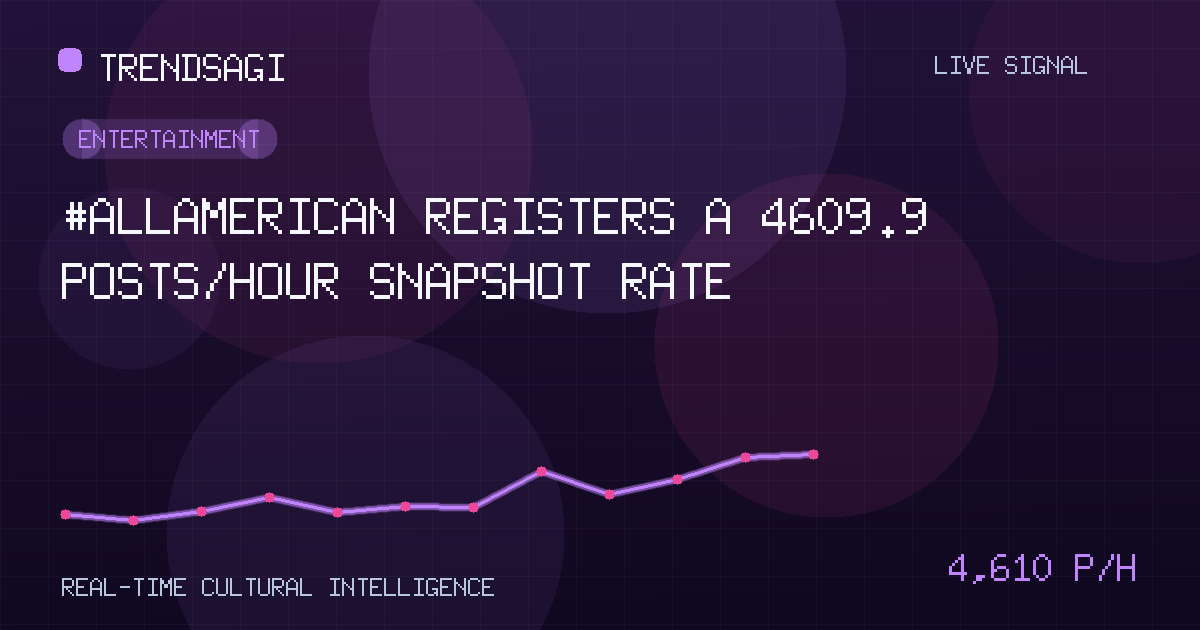
#AllAmerican Registers a 4609.9 Posts/Hour Snapshot Rate
#AllAmerican logged 1384 posts and a measured 4609.9 posts/hour snapshot rate; the trigger remains unverified.
Automated briefing. Generated from stored signal measurements and source-backed research; it is not manually reviewed. Read the methodology and limitations.
Metrics in this briefing are a snapshot associated with its publication date and may not reflect current conditions.
What changed
The clearest read is that #AllAmerican produced a concentrated burst in captured post activity, but the available evidence does not establish a specific trigger. The latest snapshot contains 1384 posts; no event, announcement, episode, or controversy is verified as the cause.
The signal’s measured snapshot rate is 4609.9 posts/hour across an exact 767-second window using 3 stored observations, observed at 2026-09-29T00:54:02Z. This is a retrospective measure of the stored feed—not a live or current rate, forecast, reach, engagement, or unique-person count. The defensible conclusion is that a measurable burst is present while its cause and durability remain unresolved.
| Observation time | 2026-09-29T00:54:02Z |
|---|---|
| Measurement window | Exact 767-second window |
| Stored observations | 3 |
| Measured snapshot rate | 4609.9 posts/hour |
| Latest snapshot volume | 1384 posts |
Why this topic may be moving
The stored category is Entertainment, but the signal description contains no event context. The hashtag does not establish whether posts concern a particular series, a cast member, promotion, criticism, or unrelated uses of the same phrase. That ambiguity matters because posts sharing a tag can point to different stories.
A concentrated burst can have several mechanisms, including:
- A timed entertainment release, announcement, promotional post, or episode-related update.
- A widely shared official post, news report, clip, or fan reaction that prompts replies and reposts.
- A controversy or news development that produces rapid, emotionally charged posting.
- Hashtag ambiguity, coordinated posting, or repeated content that raises the raw post count without representing broad participation.
These are monitoring hypotheses, not verified explanations. A public item should not be attached to the increase unless its timestamp and content establish a credible connection to the observed window.
The signal establishes that post activity was captured around #AllAmerican during a specific short window. It does not, by itself, establish why the activity occurred, who saw it, or whether it continued.
Why it matters
For entertainment and social editors, the measured rate is a reason to check the timeline, not a ready-made explanation. Reporting should distinguish between an official release, third-party coverage, audience reaction, and unrelated hashtag use. Without that separation, a raw spike could be assigned to the wrong story.
Audience and community teams should also check whether the posts converge on one subject. A burst centered on a cast member or episode may be useful for monitoring fan sentiment. A burst mixing several meanings may instead indicate broad phrase use, ambiguous collection, or a hashtag being used for multiple conversations.
Brand-safety and communications teams should not treat 1384 posts as 1384 people or as evidence of favorable sentiment. The snapshot does not report author uniqueness, geography, paid promotion, or emotional direction. It can prioritize further review, but it cannot support a claim about audience size or perception.
What to watch next
- Find a dated trigger. Use Google Search around the observation time with the exact hashtag and relevant entertainment terms. Confirm the publisher, publication time, and subject. A result published after the observation cannot explain the earlier burst, while an undated recap is not enough to establish sequence.
- Locate the earliest substantive post. If the underlying sample is available, identify the first official, news, or fan contribution and whether later posts cite, copy, quote, or react to it.
- Test persistence. Compare subsequent stored observations collected under the same query and method. Use the resulting measured snapshot rates—not the latest snapshot volume—to judge whether activity is sustained.
- Measure concentration. Check repeated wording, repost networks, and the share coming from one account or source. Count unique authors only if the dataset supports that distinction; raw posts are not people.
- Separate meanings and sentiment. Classify whether the activity concerns promotion, an episode, casting, criticism, news, or unrelated language. Positive, negative, and neutral volume should not be collapsed into one interpretation.
- Look for breadth. See whether related cast, show, episode, or topic tags enter the signal and whether verified public coverage converges on the same event. Breadth across independent sources would provide stronger evidence than repetition within one network.
Concrete signs that the interpretation is strengthening would be a timestamped public item preceding the burst, continued measured rates in later windows, multiple independent sources discussing the same subject, and related entities entering the conversation. Signs that would weaken it include duplicated content without original discussion, no comparable activity after the snapshot, or search results that point to unrelated uses of the hashtag.
Methodology and limitations
The 4609.9 posts/hour figure is a measured snapshot rate calculated from 3 stored observations over an exact 767-second window. The separate 1384-post figure is the volume in the latest snapshot. These measure different things: the rate describes change within the observed window, while snapshot volume describes the stored count at its endpoint.
The signal provides no historical baseline, post text, source breakdown, author counts, sentiment, geography, platform distribution, or information about promotional activity. It also does not establish that the hashtag refers to a single entity. Collection timing and query design may affect the result. Because no verified public trigger can be tied confidently to the timestamp, the current status is high short-window activity with an unclear cause, not a confirmed event-driven trend.
Track This Topic for New Signals
Set alerts for future velocity or sentiment changes around this topic.
Explore Tracking PlansAbout TrendsAGI research
TrendsAGI's automated research pipeline publishes dated signal snapshots, methodology notes, and practical workflows for teams evaluating cultural momentum. Read how signals are scoped, scored, and limited in our research methodology.