748-second window · 3 observations · Measured Oct 3, 2026, 1:09 PM UTC · Provider: go_recent_snapshot_v2
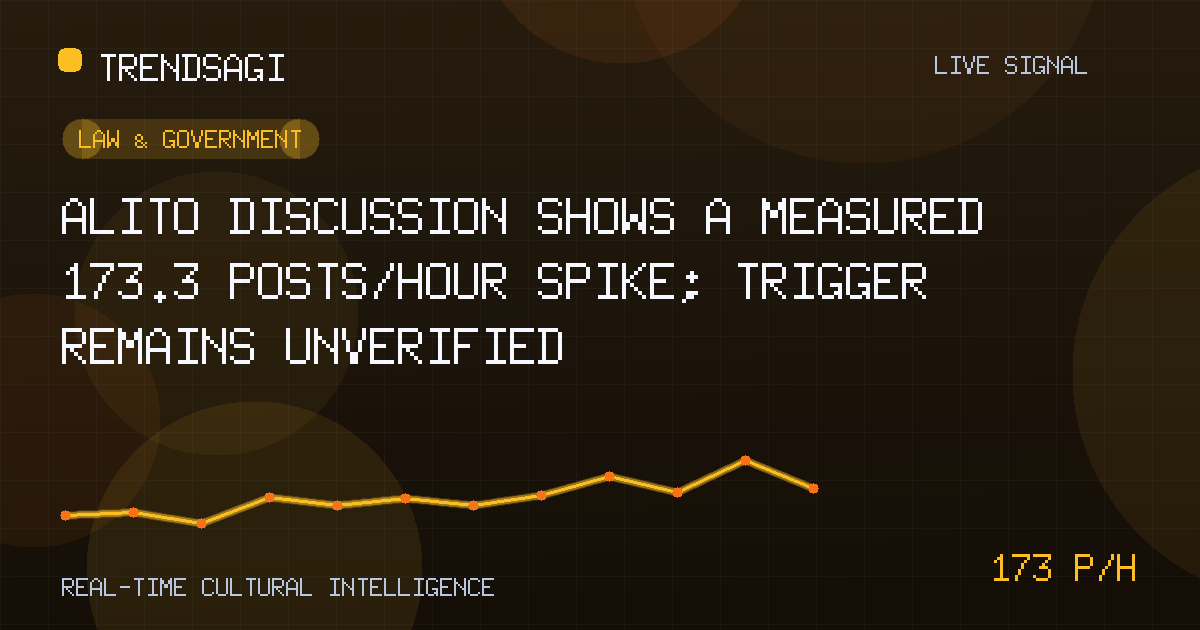
Alito discussion shows a measured 173.3 posts/hour spike; trigger remains unverified
The stored Alito signal measured 173.3 posts/hour over an exact 748-second window; this briefing separates the spike from its unverified trigger.
Automated briefing. Generated from stored signal measurements and source-backed research; it is not manually reviewed. Read the methodology and limitations.
Metrics in this briefing are a snapshot associated with its publication date and may not reflect current conditions.
What changed
The stored signal shows a sharp short-window increase in posts associated with Alito, but it does not establish what caused the increase. The answer supported by the record is limited: posting activity accelerated around the topic, while a specific event, statement, legal action, or political development behind that acceleration remains unverified. In plain terms, the cause is unclear from the available evidence.
Across an exact 748-second window, the measured snapshot rate was 173.3 posts/hour, using 3 stored observations; the measurement is timestamped 2026-10-03T13:09:27Z. The latest stored snapshot contained 115 posts. The rate is a measured snapshot rate, not a live or current rate, forecast, reach, engagement, or unique-person count.
| Observation time | Measured posts/hour | Snapshot volume |
|---|---|---|
| 2026-10-03T13:09:27Z | 173.3 posts/hour | 115 posts |
Why this topic may be moving
No verified public context in the record identifies the trigger. The label is only Alito, so it does not disambiguate the person, event, or subject being discussed. Posts could be responding to a new development, recirculating an older item, debating a legal issue, or matching the surname in unrelated ways. Those are possible explanations to test, not conclusions about this snapshot.
A fast rate can arise from several different patterns. A genuinely new event may generate reporting and reaction at once. A previously posted clip or quotation may be redistributed. A small number of prominent accounts may publish repeatedly, making the conversation look broader than it is. Alternatively, keyword matching may combine separate conversations. Without the underlying posts and their sources, the signal cannot separate these pathways.
The category, Law and Government, makes a legal or institutional explanation plausible, but it is not proof that a government body acted. A topic can be classified in that category because of its history, participants, or context even when the current burst is commentary. The signal measures the movement of matching posts; it does not measure the importance of the subject or the reliability of any claim.
173.3 posts/hour is an alert that attention moved quickly in the observed window. It is not evidence of what happened, who was involved, whether the claims are true, or how many people independently formed a view.
Why it matters
For legal and government readers, the useful question is not simply whether a name is moving. It is whether a documented development occurred, what its formal status is, and whether online posts accurately describe it. A new statement, court-related event, official record, or political exchange could matter for institutional interpretation; an old item recirculated without context could create the appearance of a new event without changing the underlying facts.
- Legal professionals should distinguish an authenticated record from commentary and determine whether the item has immediate legal significance.
- Journalists and editors should look for a primary document or an independently verified report before assigning the burst to a particular action.
- Policy readers should compare the timing of the posts with official activity and avoid treating a surname spike as a policy signal by itself.
- General readers should check whether multiple posts provide independent confirmation or merely repeat the same assertion, image, or clip.
The two supplied figures answer different questions. The 115 posts describe the size of the latest stored snapshot. The 173.3 posts/hour figure summarizes the measured change across the exact 748-second window and its 3 stored observations. Neither figure, separately or together, establishes originality, author count, sentiment, geographic spread, or impact.
That limitation is especially important in a fast-moving legal conversation. Repetition can make a claim seem settled, while a genuine event may still be surrounded by inaccurate or incomplete reactions. The right editorial response is to preserve the alert, withhold a causal label, and seek verification.
What to watch next
The next useful test is whether the burst persists and whether the posts converge on one identifiable event. A follow-up should examine the content behind the topic label rather than adding more volume estimates without context.
- Primary-source check: Look for an official document, dated statement, docket entry, transcript, or other record that can anchor the discussion.
- Independence check: See whether separate outlets or accounts cite the same underlying evidence, rather than copying one post or repeating one unsupported screenshot.
- Continuity check: Compare later snapshots with the observed one to determine whether activity remains elevated or quickly subsides.
- Topic-resolution check: Confirm which Alito is meant and whether the conversation concerns a person, a surname, a quotation, or an unrelated use of the word.
- Accuracy check: Watch for corrections, debunking, or a clear distinction between confirmed facts and speculation as the conversation develops.
Concrete warning signals include a sudden cluster of posts using the same wording without a shared source, a claim that outruns any available record, or a shift from one alleged event to several unrelated narratives. Positive confirmation would be a dated primary item, consistent independent reporting, and follow-up discussion that stays tied to that item. Persistence alone would confirm continued attention, not the truth of the story.
Methodology and limitations
This briefing is based on a stored Law and Government signal with 3 observations across an exact 748-second window. The observation time is 2026-10-03T13:09:27Z, the measured snapshot rate is 173.3 posts/hour, and the latest snapshot volume is 115 posts. These values describe the captured signal at its stated observation time; they should not be read as a live or current measurement.
The record does not provide post text, account identities, source links, sentiment, or a verified public event explaining the movement. Consequently, it cannot establish causation, credibility, reach, unique participation, or consequences. The topic label is also too broad to identify the underlying subject on its own. Until a primary record or independently verified report supplies a trigger, the responsible conclusion is continued attention without a confirmed explanation.
For now, the most accurate characterization is a notable short-window concentration of Alito-related posts with an unverified trigger. The practical value of the signal is investigative: it tells readers where attention may be developing and supplies concrete checks for deciding whether that attention reflects meaningful news.
Track This Topic for New Signals
Set alerts for future velocity or sentiment changes around this topic.
Explore Tracking PlansAbout TrendsAGI research
TrendsAGI's automated research pipeline publishes dated signal snapshots, methodology notes, and practical workflows for teams evaluating cultural momentum. Read how signals are scoped, scored, and limited in our research methodology.


