1011-second window · 3 observations · Measured Sep 23, 2026, 4:55 PM UTC · Provider: go_recent_snapshot_v2
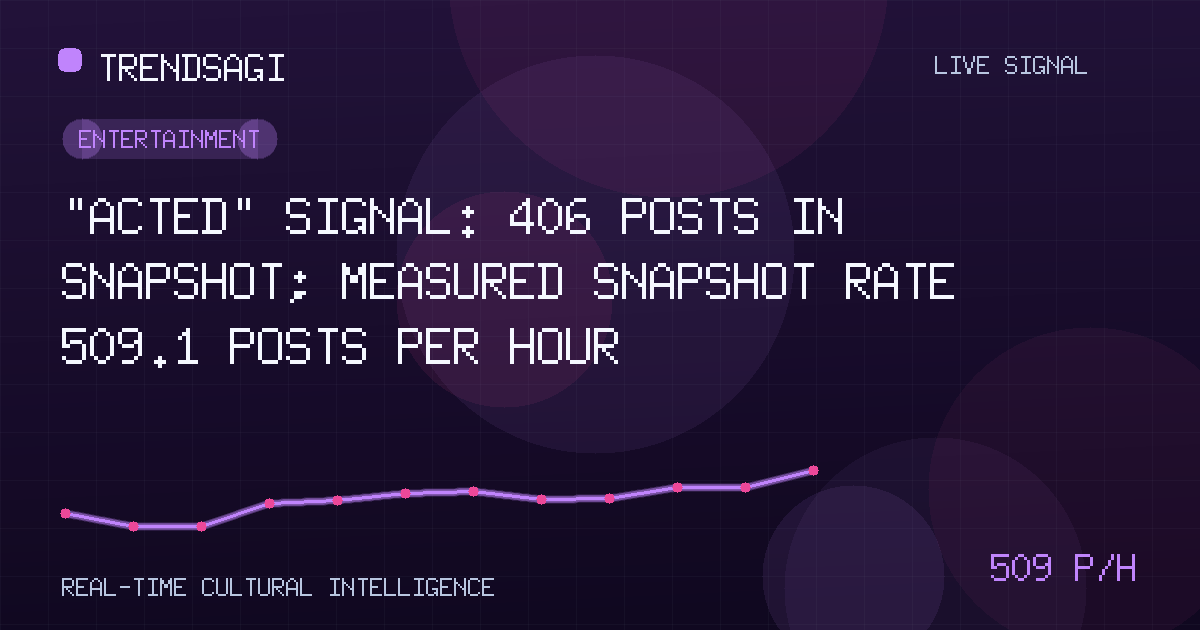
“Acted” signal: 406 posts in snapshot; measured snapshot rate 509.1 posts per hour
The “Acted” label shows 406 posts in the latest snapshot and a measured snapshot rate of 509.1 posts per hour; verify the cause before reporting a trend.
Automated briefing. Generated from stored signal measurements and source-backed research; it is not manually reviewed. Read the methodology and limitations.
Metrics in this briefing are a snapshot associated with its publication date and may not reflect current conditions.
What changed
The stored “Acted” signal shows a positive measured change: 406 posts in the latest snapshot and a measured snapshot rate of 509.1 posts per hour. This is a recorded increase in observed post activity, not evidence of a live rate or a confirmed entertainment event.
The measured snapshot rate comes from 3 stored observations across an exact 1011-second window ending at 2026-09-23T16:55:45Z. It is not a forecast, reach, engagement figure, or count of unique people.
| Measure | Stored value |
|---|---|
| Observation time | 2026-09-23T16:55:45Z |
| Measured snapshot rate | 509.1 posts per hour |
| Latest snapshot volume | 406 posts |
| Stored observations | 3 |
| Measurement window | Exact 1011-second window |
Why this topic may be moving
No verified public context establishes why “Acted” is moving, so the cause remains unclear. Its stored category is “Entertainment,” but that classification does not identify the underlying subject or demonstrate a connection to a release, performer, award event, or controversy. Those would be examples of claims requiring verification, not findings supported by this record.
The available evidence supports a narrower conclusion: the number of posts carrying the tracked label increased during the measured window. It does not show what the words represent. “Acted” could be a title, a name, part of another phrase, or a tracking label that groups different subjects. Without a supplied description or verified context, its intended meaning cannot be resolved confidently.
Any explanation involving a particular entertainment development would need a public source that directly connects that development to the collected posts. Until then, naming a trigger would add a story the evidence does not support.
The signal establishes an increase in observed posts labeled “Acted”; it does not, by itself, establish why they increased or what they mean.
Why it matters
The immediate development is a change in the observed signal, not a verified cultural or industry event. For editors and social-listening teams, this is a reason to investigate classification and collection before drawing conclusions. A label can become active because a specific subject is being discussed repeatedly, but it can also become more frequent because a query, taxonomy, or collection boundary captures a broader use of the word. The present record does not distinguish those possibilities.
Publicists, audience researchers, and entertainment analysts should not use these numbers to claim increased awareness, audience demand, or critical reaction. The record does not report impressions, reactions, sentiment, or distinct authors. Nor does it show whether a single event, several stories, or unrelated uses share the same label. A media organization may reasonably prioritize a check; it may not reasonably present the label alone as evidence of a broader trend.
The useful question is not simply whether “Acted” is moving. It is whether the tracked label represents a coherent subject closely enough for activity around it to be interpreted consistently. That makes this signal most useful as a verification and data-quality alert.
What to watch next
- Resolve the referent. Review a representative selection of the collected posts and determine what “Acted” denotes in each relevant context. Separate a named work or person from generic word usage, quoted text, credits, and unrelated material. Confirm that apparent cohesion reflects the posts rather than an assumption based on the label.
- Check collection consistency. Establish whether the same matching rule, filters, and category definition applied at all 3 observation times. Review whether a change in query behavior, tagging, or deduplication could explain part of the increase. Without a stable measurement basis, post-count comparisons can be misleading.
- Seek a dated, attributable trigger. Look for a credible public source that identifies a concrete development, establishes its timing, and connects it to the collected posts. High post volume alone is not evidence that a particular event occurred, that it was important, or that it caused the increase.
- Test whether activity persists. Compare subsequent stored observations using the same window and collection rules. Distinguish a continuing increase from stabilization or reversal; do not extend the measured snapshot rate of 509.1 posts per hour into the future. Further observations are needed before describing acceleration, a peak, or a durable shift.
- Measure the right things next. If access allows, examine unique authors, original versus reposted content, geography, platforms, and relevant text. Those checks could reveal broad participation, repeated copying, or a narrow cluster of activity. They are proposed checks, not results already present in the record.
Methodology and limitations
Volume and rate answer different questions. The snapshot-volume figure is 406 posts. The measured snapshot rate is 509.1 posts per hour, based on the supplied 3 stored observations over the exact 1011-second window. It does not mean that 406 posts accrued during that window. The rate is specific to the recorded interval and should not be carried forward as a current level.
The stored observations support reporting the supplied comparison, but they do not establish a smooth path between observations, a stable baseline, or the shape and duration of the movement. No platform coverage, sampling frame, query specification, deduplication status, or engagement measurements are provided. The signal therefore cannot establish audience size, sentiment, organic participation, or causation.
The practical conclusion is narrow: “Acted” is an unresolved label with a measured activity increase. Verify what it means, whether collection remained stable, and whether a dated public development explains the movement before presenting it as an entertainment trend.
Track This Topic for New Signals
Set alerts for future velocity or sentiment changes around this topic.
Explore Tracking PlansAbout TrendsAGI research
TrendsAGI's automated research pipeline publishes dated signal snapshots, methodology notes, and practical workflows for teams evaluating cultural momentum. Read how signals are scoped, scored, and limited in our research methodology.