32-minute window · 3 observations · Measured Oct 2, 2026, 2:56 AM UTC · Provider: go_recent_snapshot_v2
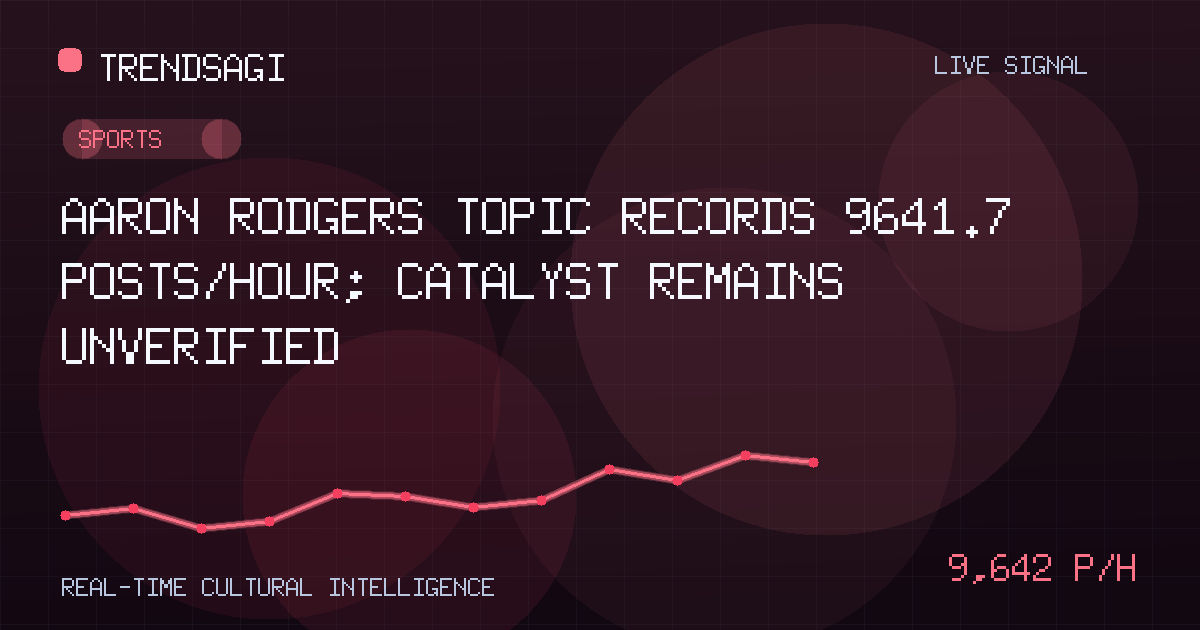
Aaron Rodgers topic records 9641.7 posts/hour; catalyst remains unverified
The Aaron Rodgers topic logged 9641.7 posts/hour in the stored window; the cause is unverified, with practical checks for editors and readers.
Automated briefing. Generated from stored signal measurements and source-backed research; it is not manually reviewed. Read the methodology and limitations.
Metrics in this briefing are a snapshot associated with its publication date and may not reflect current conditions.
What changed
The Aaron Rodgers topic recorded a measured rise in posting activity, but no verified public catalyst has been established for this briefing. The defensible conclusion is that conversation accelerated around the name, not that a specific game, career decision, endorsement, controversy, or personal event caused the activity.
The measured change is 9641.7 posts/hour over an exact 1920-second window using 3 stored observations, with the latest snapshot observed at 2026-10-02T02:56:03Z. That snapshot contained 10285 posts. This is a measured snapshot rate, not a live or current rate, forecast, reach, engagement figure, or unique-person count; snapshot volume is not a rate.
| Metric | Stored value |
|---|---|
| Observation time | 2026-10-02T02:56:03Z |
| Measured posts/hour | 9641.7 posts/hour |
| Snapshot volume | 10285 posts |
Why this topic may be moving
The stored record is strong evidence of a change in posting velocity during the measured window, but it is not evidence of a cause. No dated, verified public development has been tied to the signal, so the reason for the movement remains unclear.
Several mechanisms could create a topic-level burst. They should be treated only as verification hypotheses:
- Sports news: a game result, team update, roster matter, or other development could be prompting reaction.
- A public appearance: an interview, broadcast exchange, social statement, or reported remark could be driving discussion.
- Resurfaced material: an older clip, quotation, or prior controversy could be recirculating without a new underlying event.
- Rumor or correction: speculation may be spreading, or a correction may be generating a renewed wave of posts.
- Amplification: repeated sourcing, high-volume accounts, or automated posting could contribute to the count.
A rapid topic signal is a reason to verify, not evidence that the underlying claim is true, new, or important.
What the signal can and cannot establish
It can establish a precise, timestamped fact: within the stated window, the stored observations registered 9641.7 posts/hour, and the latest snapshot held 10285 posts. That is enough to prioritize a check at the observation time.
- It does not show how many distinct people participated; multiple posts can come from one account, and reposted or duplicated material may be counted.
- It does not establish sentiment, agreement, factual accuracy, or whether a claim was confirmed, denied, or ignored.
- It does not reveal the geographic, language, or platform mix of the conversation.
- It does not provide a historical baseline, so the rate should not be labeled a record, normal level, or durable trend.
- It says nothing reliable about activity after 2026-10-02T02:56:03Z.
Why it matters
For sports editors, the immediate risk is confusing attention with confirmation. A fast-moving topic can trigger a headline before the underlying event is known. The responsible response is to report the measured movement, state that the catalyst is unverified, and avoid converting a plausible rumor into news.
For fans and general readers, the signal says that the name was being discussed intensely in the measured store, not that every popular post is accurate. Readers should inspect what is actually being claimed before sharing it.
For media and monitoring teams, this is a prioritization case. The useful question is not simply “Is Aaron Rodgers trending?” but “What new, checkable claim explains the activity, and is that explanation supported?” Velocity can identify where editorial attention is warranted; it cannot answer those questions by itself.
What to watch next
- Preserve the measurement boundaries. Compare the next stored observation time, measured posts/hour, and snapshot volume only with like-for-like records. Do not carry 9641.7 posts/hour forward as a live rate or treat 10285 posts as a cumulative audience total.
- Look for a dated first-party explanation. Check relevant official team, league, player, or event channels for a statement or announcement whose timing fits the observed window. A first-party post verifies that the organization or person communicated something; it does not automatically validate every claim attached to it.
- Require independent corroboration. See whether reputable outlets identify the same underlying event, agree on basic facts, and distinguish direct reporting from reaction or speculation.
- Inspect the content, not just the count. Determine whether posts point to new information, recycle an older clip, copy one source, answer an earlier rumor, or mainly express reaction. Those patterns help distinguish a genuine information event from amplification.
- Track corrections and denials. A clarification can create another wave. Record who corrected what, when the correction appeared, and whether the measured rate changes in a subsequent snapshot.
- Test persistence. A verified catalyst plus continued measured activity across later stored windows would support an event-driven trend. A falling rate with no verified explanation would leave the burst transient and causally ambiguous.
Methodology and limitations
This briefing uses the stored snapshot observed at 2026-10-02T02:56:03Z. The reported 9641.7 posts/hour was measured over the exact 1920-second window from 3 observations. The 10285 figure is the latest snapshot volume. These values describe what was recorded at that point; they are not projections.
No verified public catalyst was available for this briefing, so no external event is asserted as the cause. The topic’s stored Sports category provides broad context, but it cannot substitute for event-level verification.
The main limitations are the limited observation set, the absence of a supplied historical baseline, and the lack of details about collection coverage, account duplication, sentiment, and geography. As a result, the signal can support timely investigation and resource prioritization, but not a factual account of why Rodgers was being discussed. The strongest next evidence would be a timestamp-matched public source followed by independent confirmation.
Track This Topic for New Signals
Set alerts for future velocity or sentiment changes around this topic.
Explore Tracking PlansAbout TrendsAGI research
TrendsAGI's automated research pipeline publishes dated signal snapshots, methodology notes, and practical workflows for teams evaluating cultural momentum. Read how signals are scoped, scored, and limited in our research methodology.


