922-second window · 3 observations · Measured Sep 28, 2026, 10:55 PM UTC · Provider: go_recent_snapshot_v2
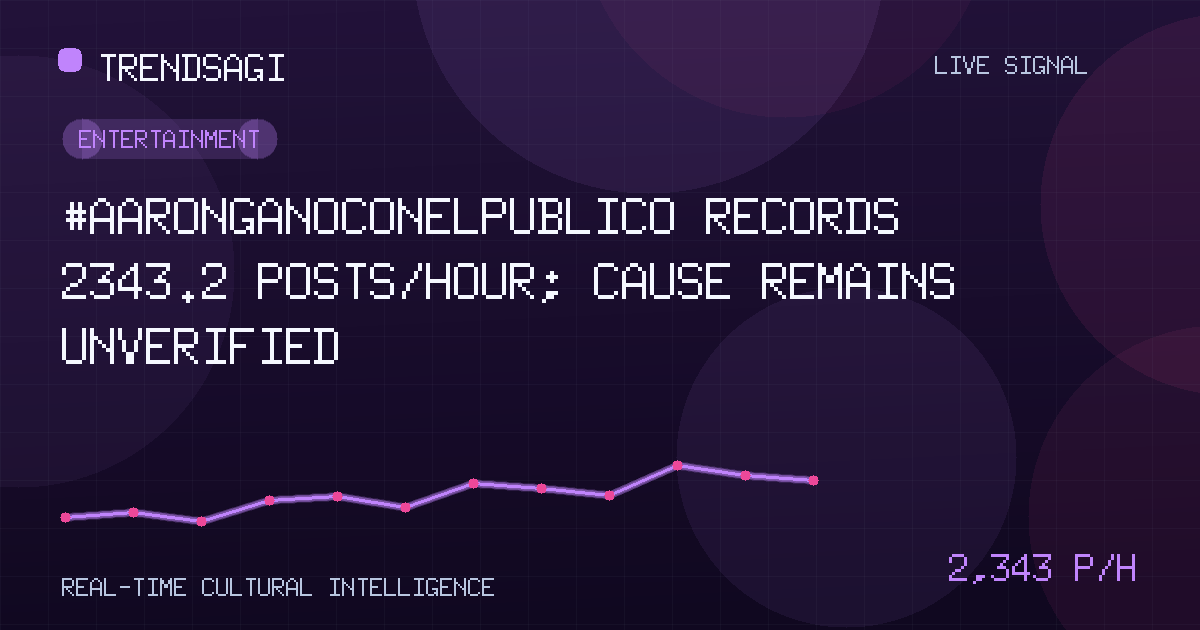
#AaronGanoConElPublico records 2343.2 posts/hour; cause remains unverified
#AaronGanoConElPublico measured 2343.2 posts/hour over 922 seconds; readers can see the spike, its limits, and the checks needed to verify why.
Automated briefing. Generated from stored signal measurements and source-backed research; it is not manually reviewed. Read the methodology and limitations.
Metrics in this briefing are a snapshot associated with its publication date and may not reflect current conditions.
What changed
#AaronGanoConElPublico is showing a concentrated burst in tracked posts, but no verified public trigger has been established. The useful conclusion is that the conversation accelerated enough to merit monitoring, not that a particular event, announcement, release, or controversy caused it.
The measured change was 2343.2 posts/hour across an exact 922-second window using 3 stored observations, with the latest observation at 2026-09-28T22:55:38Z. This is a measured snapshot rate: it is not a live or current rate, forecast, reach, engagement, or unique-person count.
| Observation time | Measured snapshot rate | Snapshot volume |
|---|---|---|
| 2026-09-28T22:55:38Z | 2343.2 posts/hour | 3600 posts |
The latest snapshot volume associated with the signal was 3600 posts. Volume and rate should not be conflated: 3600 describes the size of the tracked snapshot, while 2343.2 posts/hour describes the measured change during the stated window. Neither figure, by itself, shows how many people participated or how far the conversation spread.
What the signal can establish
The signal establishes that activity attached to this tracked label increased rapidly during a narrow period and that the acceleration was captured across multiple readings. It can prioritize the topic for review and provide a baseline for comparing later snapshots.
It cannot establish sentiment, authenticity, organic versus coordinated behavior, geography, language, platform reach, or the identity of the accounts driving activity. It also cannot show whether the burst continued after the observed window.
Most importantly, the tracked volume is not a list of 3600 distinct participants. Reposts, repeated text, quoted posts, and multiple posts from the same account can affect a post count, but the available record does not show how those cases were handled.
Why this topic may be moving
No verified public context identifies a specific trigger for the increase, so the cause is unclear. The Entertainment classification describes how the signal was categorized, but it does not verify that an entertainment event occurred.
Possible explanations include a new public post, a clip or interview recirculating, a live appearance, audience coordination, reaction to existing content, or amplification by a platform recommendation system. These are hypotheses to test, not findings. None should be reported as the cause without a timestamped public source that predates or coincides with the acceleration.
The strongest conclusion is that tracked conversation accelerated during a short window. The trigger, audience response, authenticity, and persistence of that acceleration still require verification.
The key diagnostic distinction is concentration versus breadth. A burst driven by a small set of accounts repeating similar material looks different from a broad pickup across many independent accounts, even when total post volume is identical. Without post text and account-level records, this signal cannot separate those patterns.
Why it matters
For an entertainment or communications team monitoring Aaron Gano, the immediate issue is attention triage. A verified event may warrant audience messaging, content review, or a rapid response. An unverified and highly concentrated burst may instead be a measurement, spam, or coordination question. Acting before cause and audience composition are known risks amplifying the signal unnecessarily.
For journalists, analysts, creators, and rights holders, the value is knowing where to look next rather than declaring a trend winner. The figures support a claim of increased posting activity at the observed time. They do not support claims about public approval, backlash, popularity, or commercial impact. That distinction helps prevent a high-volume conversation from being mistaken for broad consensus.
What to watch next
Use the next comparable snapshots to answer several practical questions:
- Persistence: Compare the next snapshot using the same topic definition and matching basis. A decline would support a short spike; continued or stronger activity would indicate greater durability.
- Concentration: Review distinct authors, repeated wording, reposts, quoted posts, and reuse of the same media. Participation across independent accounts is stronger evidence of organic reach than many posts from a narrow account set.
- Origin: Identify the earliest posts that appear to accelerate the conversation, then inspect nearby replies and quoted posts. An early, rapidly accumulating item is more useful for explaining the rise than a currently popular post.
- Trigger verification: Check official accounts and established publishers for a dated announcement, appearance, release, interview, or controversy that can be independently confirmed. A plausible trigger should be timestamped before, or at least at, the start of the rise.
- Content: Code the recurring subject, framing, claims, and emotional tone. Separate original reactions from duplicate or repurposed material before describing the conversation as positive, negative, or neutral.
- Spread and quality: Compare participating accounts, locations, languages, and adjacent hashtags, and look for signs of automation or coordinated posting. These checks show whether activity is expanding across communities or being repeated inside one.
Decision rule: Treat the movement as substantive when public context verifies a trigger, subsequent comparable snapshots show persistence, and account-level review finds participation beyond a narrow cluster. If those tests fail, describe it as an unverified posting burst rather than a confirmed event-driven trend.
Methodology and limitations
The measurement covers an exact 922-second window ending at 2026-09-28T22:55:38Z and uses 3 stored observations. The supplied measured change rate is 2343.2 posts/hour. The separate latest snapshot volume is 3600 posts. These values are reproduced as recorded; the rate has not been converted into a post total or a live estimate.
Because the record does not include matching rules, deduplication, post text, account identities, engagement, or collection errors, the result cannot be independently audited for uniqueness or authenticity. It also does not show what happened before or after this window. A later high or low reading should not be inferred from this snapshot.
No external fact is presented as the cause because no public trigger was verified. This briefing therefore distinguishes an observed posting acceleration from an explanation of why it happened. Additional snapshots, account-level review, and source-level verification are required before assigning significance, sentiment, or reach.
Track This Topic for New Signals
Set alerts for future velocity or sentiment changes around this topic.
Explore Tracking PlansAbout TrendsAGI research
TrendsAGI's automated research pipeline publishes dated signal snapshots, methodology notes, and practical workflows for teams evaluating cultural momentum. Read how signals are scoped, scored, and limited in our research methodology.