1796-second window · 3 observations · Measured Sep 28, 2026, 7:09 AM UTC · Provider: go_recent_snapshot_v2
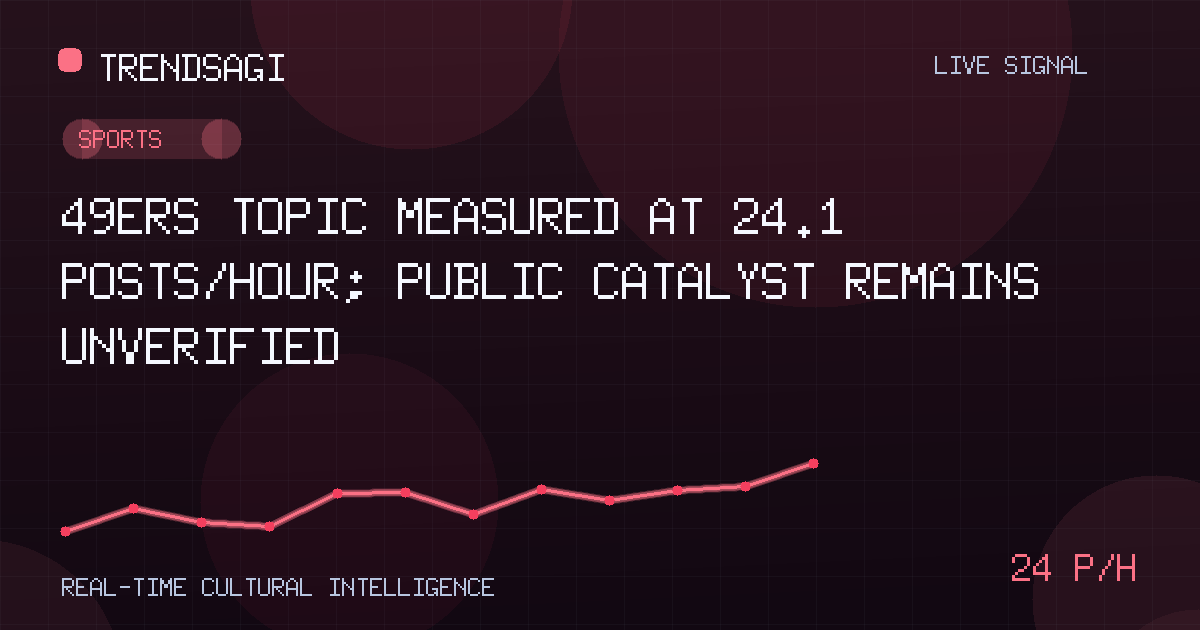
49ers topic measured at 24.1 posts/hour; public catalyst remains unverified
The 49ers signal contains 84 posts and a measured snapshot rate of 24.1 posts/hour, while the event driving attention remains unverified.
Automated briefing. Generated from stored signal measurements and source-backed research; it is not manually reviewed. Read the methodology and limitations.
Metrics in this briefing are a snapshot associated with its publication date and may not reflect current conditions.
What changed
The 49ers topic generated 84 posts in the latest snapshot. That makes the feed a priority for quick verification, but it does not identify the event driving attention. No game result, injury, roster decision, or other public catalyst has been independently confirmed for this briefing.
The measured snapshot rate was 24.1 posts/hour over an exact 1,796-second window, based on three stored observations, with the latest observation at 2026-09-28 07:09:24 UTC. The figure describes that measured window; it is not a live rate, forecast, reach estimate, engagement count, or count of distinct people.
| Observation time | Measured posts/hour | Snapshot volume |
|---|---|---|
| 2026-09-28 07:09:24 UTC | 24.1 | 84 posts |
Why this topic may be moving
The reason the topic is moving remains unclear. The stored measurement records a measured snapshot rate around the 49ers label, but it contains no verified event claim that can be attributed to a public source. Without corroboration, describing the activity as reaction to a specific development would turn an editorial lead into an unsupported fact.
Several mechanisms could produce this pattern: a game outcome, an injury or availability update, a roster transaction, a coaching or front-office development, a player-related controversy, or ordinary scheduled coverage amplified by a large conversation. Those are categories to test, not findings. The current evidence does not show which, if any, is responsible.
The signal is a reason to check the 49ers feed, not evidence of a specific event. Editorial value comes from confirming the catalyst before turning volume into a story.
What the signal can and cannot establish
The signal can establish two narrow facts: the monitored data contained 84 posts at the stated snapshot, and its observations yielded a measured snapshot rate of 24.1 posts/hour for the stated window. It can therefore flag a concentrated area of activity for monitoring and help an editor decide where to look next.
- Whether activity persists beyond the measured window.
- Whether posts come from independent accounts or are copies, reactions, or automatic updates.
- Whether discussion is broad or concentrated in one community.
- Which concrete terms, names, or claims recur in the posts.
It cannot establish how large the underlying audience was, how sentiment changed, where participants were located, whether the activity was organic, or whether an organization was involved. Because no baseline is supplied here, the signal also cannot by itself show acceleration, a record, or a durable shift in interest.
Why it matters
For a sports desk, the immediate value is triage. A rise in topic-level posting can expose a developing story before a routine scan catches it, but publishing the inferred cause too early can amplify a rumor or misstate the news. The responsible move is to separate the observed conversation from the unverified explanation.
Team and league communications staff can use the signal to watch for rumor formation and inconsistent messaging. Media teams can compare it with their own audience data, while researchers can treat it as a trigger for collection rather than a conclusion. Even this measured snapshot rate says nothing about conversion, loyalty, or business impact.
Readers also need the distinction because high posting volume can create an appearance of consensus. Many posts repeating one claim may still represent a narrow origin, while a smaller set of original posts may be more informative. Volume locates the activity; verification establishes its meaning.
What to watch next
The next useful check is not another generic trend label. It is evidence that resolves the open question of cause. Work through the following sequence:
- Inspect the post sample. Read the actual text and timestamps, identify repeated wording, and separate original posts from reposts or automated notices. Look for the first appearance of any specific claim.
- Find the earliest credible catalyst. Check official team, league, and player communications, then compare any claim with independent reporting. The relevant standard is confirmation, not popularity.
- Measure persistence. Compare the next available observation with this one. A continued rate near the recorded level would support sustained attention; a sharp reversal would suggest a short-lived cluster. Neither result alone identifies the cause.
- Check source diversity. Determine whether activity spans independent accounts and locations or remains concentrated in one account group. Broader participation supports wider attention, while repetition may explain the headline volume without broad reach.
- Track the language. Note whether posts repeatedly mention the same person, event, injury, transaction, or allegation. Convergence on a checkable fact is more useful than generic use of the team name.
- Align the timeline. Compare the onset of posts with the publication time of any candidate news. A catalyst that appeared after the conversation began is unlikely to explain its initial rise, while a verified earlier event may.
A concrete watch signal would be an official confirmation or credible independent report that supplies the missing catalyst. Another would be continued activity in later observations, especially if original posts broaden beyond a single source. If neither occurs, the editorial status remains an unexplained 49ers topic cluster rather than a confirmed development.
Methodology and limitations
The latest snapshot was observed at 2026-09-28T07:09:24Z and contained 84 posts. The measured snapshot rate is 24.1 posts/hour across an exact 1,796-second window using three stored observations. Snapshot volume and measured rate are reported separately; neither is converted into the other.
The record does not provide the underlying post text, account identities, prior baseline, geographic distribution, sentiment, engagement, or duplication status. Those omissions limit conclusions about who participated, what they thought, or how the topic compared with normal activity. No public catalyst was independently verified, so this briefing does not attribute the movement to any specific event.
Track This Topic for New Signals
Set alerts for future velocity or sentiment changes around this topic.
Explore Tracking PlansAbout TrendsAGI research
TrendsAGI's automated research pipeline publishes dated signal snapshots, methodology notes, and practical workflows for teams evaluating cultural momentum. Read how signals are scoped, scored, and limited in our research methodology.