902-second window · 3 observations · Measured Sep 30, 2026, 3:22 PM UTC · Provider: go_recent_snapshot_v2
“2 No” snapshot recorded 2838.9 posts/hour, but cause remains unverified
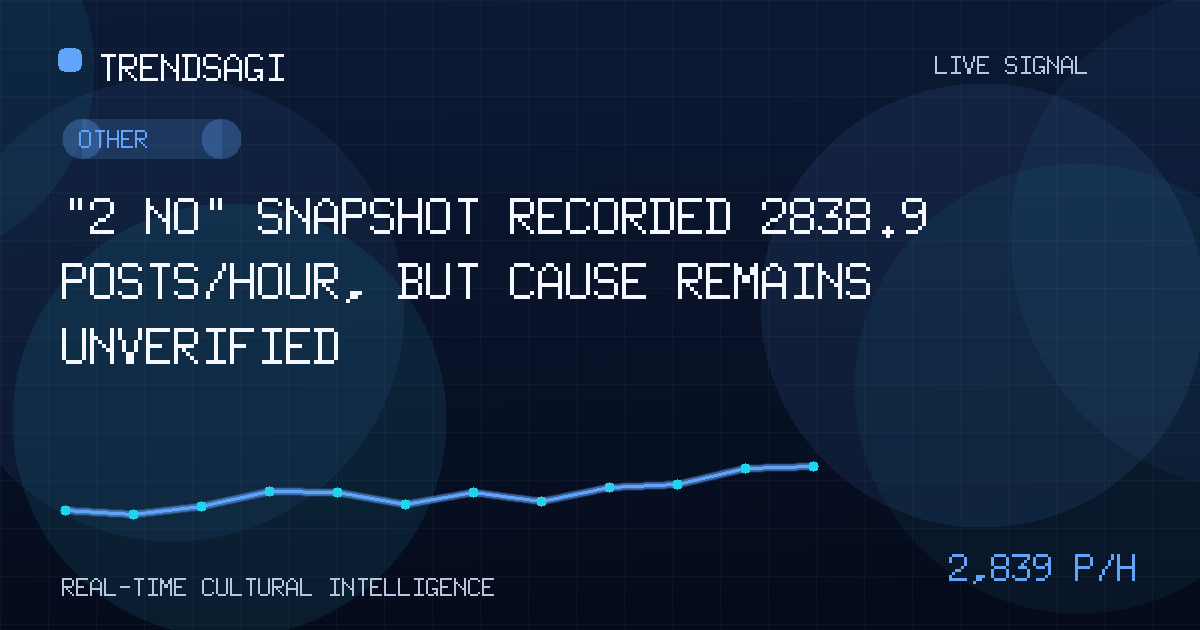
The “2 No” snapshot recorded 2838.9 posts/hour over an exact 902-second window; this briefing separates measurement from unsupported claims about cause.
Automated briefing. Generated from stored signal measurements and source-backed research; it is not manually reviewed. Read the methodology and limitations.
Metrics in this briefing are a snapshot associated with its publication date and may not reflect current conditions.
What changed
The direct answer is that the stored signal shows a rapid burst of posts associated with the label “2 No,” while the topic’s meaning and cause remain unverified. The label names no person, organization, place, product, or event, and no verified public context in this briefing ties the activity to a specific development. It should therefore be treated as an ambiguous, fast-moving signal rather than a substantive public trend.
The signal’s measured snapshot rate was 2838.9 posts/hour. It was measured over an exact 902-second window using 3 stored observations, with the latest observation at 2026-09-30T15:22:10Z. That latest snapshot contained 4500 posts. The rate describes change within the stored window; it is not a live or current rate, a forecast, reach, engagement, or a count of unique people. The 4500 figure is snapshot volume, not posts per hour.
| Observation time | Measured snapshot rate | Snapshot volume |
|---|---|---|
| 2026-09-30T15:22:10Z | 2838.9 posts/hour | 4500 posts |
Why this topic may be moving
Because the label has no description and sits in the stored category “Other,” it supplies no reliable semantic bridge to an event. The cause is unclear, not merely missing commentary: no verified public explanation meets the evidence standard for this briefing.
- A short phrase may be reused across unrelated conversations.
- The numeral may function as a list marker, ranking, or transcript fragment.
- Repeated or copied text may increase volume without representing independent discussion.
- A matching or classification error may group unrelated records under one label.
These are mechanisms to test, not findings. A news event, platform change, controversy, or coordinated activity must not be inferred from speed alone. Public verification would require a publisher’s dated account that explicitly connects the phrase to the relevant development and explains the observed timing. Until that link exists, attributing the movement to a trigger would overstate the evidence.
The strongest supported conclusion is that the stored system saw posts assigned to an ambiguous label move quickly during a short window—not that the public has adopted a position or reacted to a defined event.
What the signal can and cannot establish
The record establishes the exact stored label, observation time, snapshot volume, and measured snapshot rate. It also shows temporal clustering within the observations used for the measurement.
- There was measurable post activity associated with “2 No” in the stored collection.
- The observed change rate applies only to the stated 902-second measurement window.
- The latest stored snapshot contained 4500 posts.
It does not establish:
- how much of the wider online conversation the collection covers;
- the source platform, geography, language, or collection method;
- how many unique authors or accounts participated;
- whether the activity was organic, automated, copied, or coordinated;
- the posts’ sentiment, audience reach, factual accuracy, or likely continuation.
Why it matters
A fast-moving but unclassified label can create a false sense of scale if readers assume that every matching post refers to the same subject. Editors and communications teams could waste time responding to an ambiguous phrase, while researchers could draw an invalid conclusion from volume alone.
- Trend editors should require a coherent referent and inspect representative records before naming an issue or actor.
- Community and risk teams should distinguish genuine independent discussion from repeated text or unrelated matches before escalating the signal.
- Researchers and analysts should preserve the raw sample, matching method, and coverage limits so the measured snapshot rate remains reproducible and properly bounded.
What to watch next
- Audit the raw matches. Inspect records around the observation time and capture the exact matched text, surrounding sentences, source identifiers where available, and any attached media context.
- Test label quality. Determine whether “2 No” appears as an exact phrase, a case or punctuation variant, a substring, or an inferred topic assignment. Unrelated matches should be separated from genuine uses.
- Check duplication. Review repeated wording, account overlap, copied passages, and synchronized timing. These checks can identify concentration without assuming automation or coordination.
- Resolve the referent first. If the sample suggests an entity or event, use targeted Google Search with the exact phrase, candidate referent, and relevant date. Accept a causal explanation only when an identifiable publisher explicitly connects the phrase to that development.
- Compare like-for-like windows. Use the same topic definition and collection method for earlier and later observations. This would show whether the activity was isolated, recurring, or part of a broader pattern.
- Track taxonomy changes. A corrected label, merged topic, or removal of false matches would materially change how the stored signal should be interpreted.
Concrete signs of validation would include raw posts converging on one named referent, dated publisher corroboration, continued activity in subsequent stored observations, and broader text or account diversity rather than repeated content. If records remain semantically unrelated or highly duplicated, those findings would instead favor an ambiguous-label or collection artifact explanation. Until then, the appropriate posture is to watch the signal without attributing a cause.
Methodology and limitations
The figures reported here come directly from the stored snapshot. The 2838.9 posts/hour figure is a measured snapshot rate based on 3 stored observations over an exact 902-second window ending at 2026-09-30T15:22:10Z. It is not a live rate or forecast. The separate 4500-post figure is the volume in the latest snapshot and must not be interpreted as a rate, reach, or unique-person count.
Collection coverage, sampling, deduplication, platform mix, geography, language, and account verification are not available. The stored description is blank and the category is “Other,” so the label itself provides no reliable subject definition. No verified public context established why the topic was moving; accordingly, this briefing identifies plausible checks but does not present any of them as the cause.
Track This Topic for New Signals
Set alerts for future velocity or sentiment changes around this topic.
Explore Tracking PlansAbout TrendsAGI research
TrendsAGI's automated research pipeline publishes dated signal snapshots, methodology notes, and practical workflows for teams evaluating cultural momentum. Read how signals are scoped, scored, and limited in our research methodology.


