30-minute window · 3 observations · Measured Sep 30, 2026, 2:06 PM UTC · Provider: go_recent_snapshot_v2
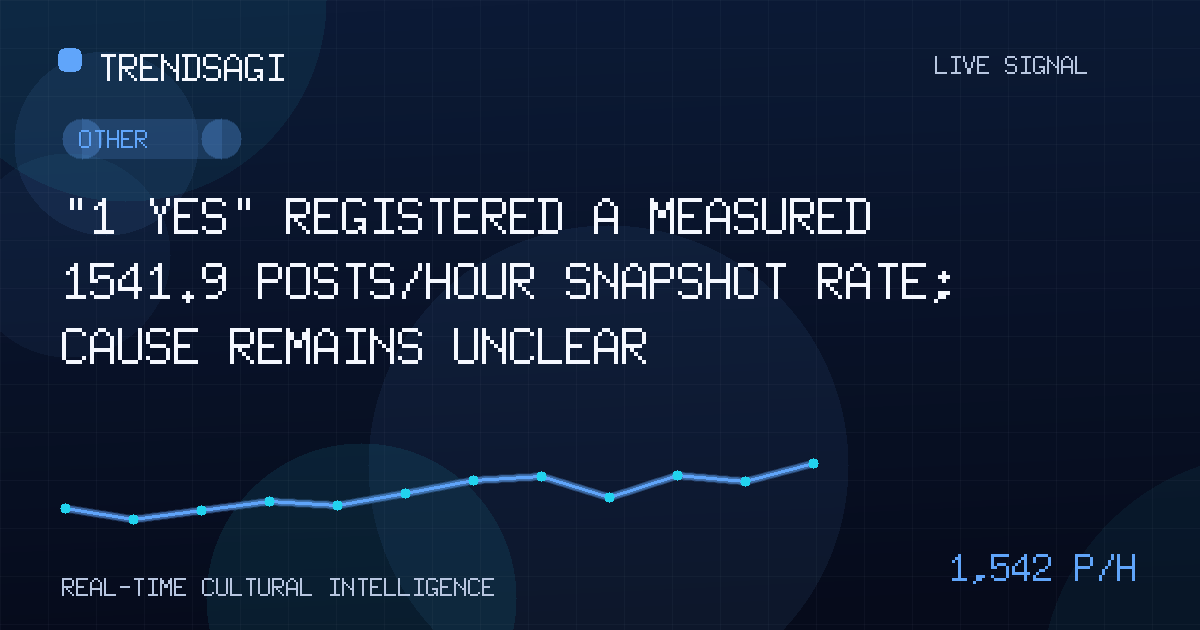
“1 Yes” registered a measured 1541.9 posts/hour snapshot rate; cause remains unclear
The “1 Yes” snapshot logged 2571 posts and a measured 1541.9 posts/hour; its ambiguous label leaves the cause unverified.
Automated briefing. Generated from stored signal measurements and source-backed research; it is not manually reviewed. Read the methodology and limitations.
Metrics in this briefing are a snapshot associated with its publication date and may not reflect current conditions.
What changed
The direct answer is narrow: the latest stored snapshot contains 2571 posts associated with the exact label “1 Yes,” and its measured snapshot rate was 1541.9 posts/hour. That is an observed cluster, but it does not reveal what the label refers to. No verified public context connects the phrase to a specific event or issue, so the reason for the movement remains unclear.
The 1541.9 posts/hour figure was measured at 2026-09-30T14:06:27Z over an exact 1800-second window using 3 stored observations. It is a retrospective snapshot rate, not a live or current rate, forecast, reach estimate, engagement measure, or unique-person count. The 2571 figure is snapshot volume, not a rate. Neither number establishes who posted, whether the posts are original, or whether activity will continue.
| Observation time | Measured posts/hour | Snapshot volume |
|---|---|---|
| 2026-09-30T14:06:27Z | 1541.9 posts/hour | 2571 posts |
Why this topic may be moving
“1 Yes” is not a self-explanatory topic label. It could be an answer to a preceding question, a numbered choice, a poll response, a transcript fragment, or a malformed ingest label. These are possibilities, not verified explanations. If matching relies on the phrase alone, unrelated conversations could be combined and made to look like a single surge.
A verified explanation would need a contemporaneous public source that uses the same wording, resolves the same referent, and connects it to the observation window. A page containing “1,” “yes,” or “1 Yes” in another setting would not establish that cause. Without that match, selecting an event would be speculation rather than trend analysis.
What the signal can—and cannot—establish
The quantitative finding is usable as a routing signal: it identifies a label and a window that merit inspection.
- It can establish: the stored label, the latest snapshot volume, the measured snapshot rate, and the time associated with that measurement.
- It cannot establish: the label’s meaning, the event behind it, the platforms or locations involved, or whether the posts share one subject.
- It also does not show: unique authors, original versus copied content, engagement, sentiment, authenticity, persistence after the window, or causation.
A high measured posting rate can identify where to investigate, but an ambiguous label cannot supply the answer.
Why it matters
For editors and trend analysts, the main risk is false interpretation. A short label can acquire a plausible story faster than its underlying posts can be checked. Reporting it as a reaction to a named event would add context the evidence does not contain.
Community, trust, and reputation teams also need care. A phrase-only cluster can combine duplicates, unrelated answers, or automated repetition; none of those possibilities should be treated as confirmed. Conversely, dismissing the cluster outright could discard a real event signal. The appropriate response is temporary uncertainty, followed by record-level validation.
Readers should treat the measurement as a prompt to investigate, not evidence of what people believe or why they are posting.
What to watch next
The next checks should move from the aggregate label to the underlying records:
- Inspect raw posts. Review a representative selection across the window and capture available source, timestamp, post identifier, surrounding text, and referral context. Do not infer meaning from the category label alone.
- Classify referents. Group posts by what “1 Yes” appears to answer or describe, while keeping the exact phrase separate from case, punctuation, and wording variants. Merging those categories too early could create the apparent trend.
- Check duplication and origin. Look for repeated text, cross-posts, syndicated feeds, and common referral paths. Similarity is a clue, not proof; preserve the distinction between a post and a unique person.
- Test persistence. Recalculate the same measure in adjacent and later windows with unchanged extraction rules. A brief cluster and a continuing phenomenon call for different descriptions.
- Verify externally with Google Search. Search the exact phrase and decisive terms from the post samples. Accept a page as explanatory only when its wording, referent, publication timing, and connection to the cluster can be checked; omit unrelated results.
- Repair the metadata. Add a signal description and more specific category only after the referent is supported. If records point to different subjects, label the signal unresolved or split it rather than inventing a unified topic.
Concrete watch signals
- Convergence: successive samples describe the same referent rather than different uses of the phrase.
- Independent corroboration: timestamped public pages connect that referent to a specific event without relying on the post cluster itself.
- Persistence: later comparable windows continue to register activity under the same matching logic.
- Source diversity: the cluster is not reducible to one account, feed, or duplicated text.
- Context divergence: samples repeatedly resolve to unrelated subjects, indicating a labeling or extraction artifact rather than a substantive trend.
Methodology and limitations
The reported rate comes from the canonical stored signal: 3 observations across an exact 1800-second window, measured at 2026-09-30T14:06:27Z. This briefing does not recompute, extend, or forecast it. The separate 2571 value is the latest snapshot volume. Posts are not equivalent to people, and neither figure measures reach or engagement.
The central limitation is semantic. The label has no accompanying description, and no verified external match establishes a cause. The record also does not provide enough methodological detail to assess label-matching precision, platform coverage, duplication, or geographic scope. Accordingly, the rate is reported exactly as a measured snapshot, while causal interpretation remains open pending the checks above.
Track This Topic for New Signals
Set alerts for future velocity or sentiment changes around this topic.
Explore Tracking PlansAbout TrendsAGI research
TrendsAGI's automated research pipeline publishes dated signal snapshots, methodology notes, and practical workflows for teams evaluating cultural momentum. Read how signals are scoped, scored, and limited in our research methodology.