920-second window · 3 observations · Measured Sep 26, 2026, 2:56 PM UTC · Provider: go_recent_snapshot_v2
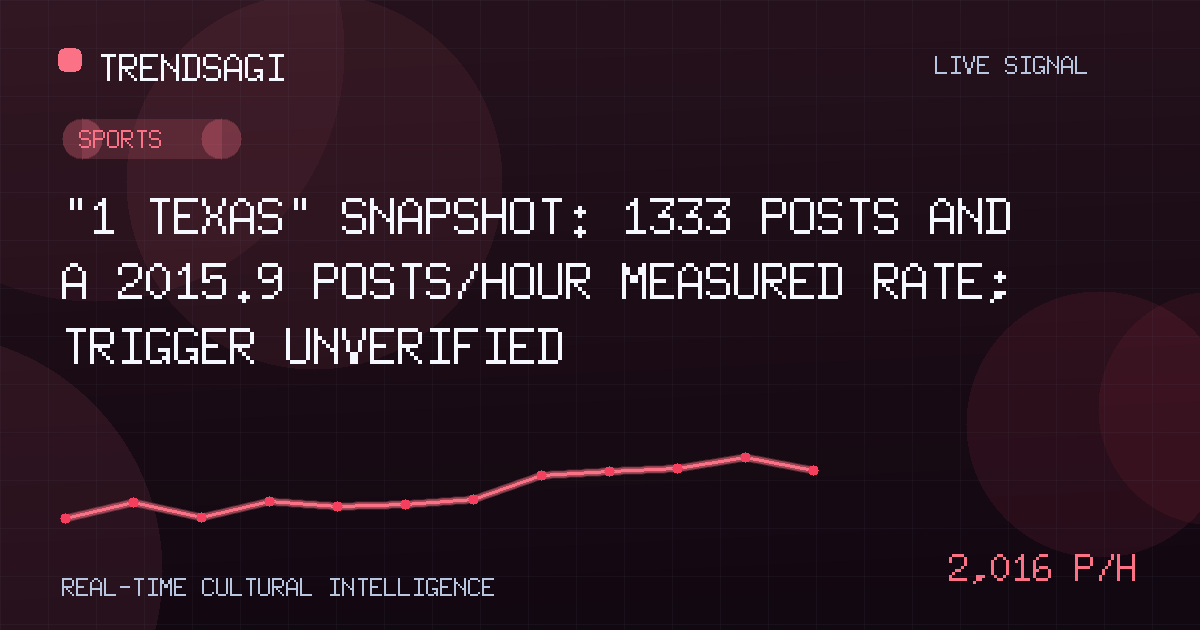
“1 Texas” snapshot: 1333 posts and a 2015.9 posts/hour measured rate; trigger unverified
“1 Texas” logged 1333 posts and a measured 2015.9 posts/hour snapshot rate; the triggering event remains unverified.
Automated briefing. Generated from stored signal measurements and source-backed research; it is not manually reviewed. Read the methodology and limitations.
Metrics in this briefing are a snapshot associated with its publication date and may not reflect current conditions.
What changed
The monitored “1 Texas” topic accelerated in the sampled conversation. The latest snapshot contains 1333 posts, while the associated measured snapshot rate is 2015.9 posts/hour. The narrow conclusion is that monitored posting moved quickly; the record does not yet identify a verified event behind it.
The rate was measured at 2026-09-26T14:56:38Z over an exact 920-second window using 3 stored observations. It is a retrospective snapshot measurement—not a live or current rate, forecast, reach figure, engagement figure, or unique-person count. No independently verified public context explains the movement, so the answer to “why is this moving?” remains unclear.
| Observation time | Measured snapshot rate | Snapshot volume |
|---|---|---|
| 2026-09-26T14:56:38Z | 2015.9 posts/hour | 1333 posts |
Why this topic may be moving
One obstacle is the label itself. “1 Texas” is not a specific event name, and the Sports category does not establish whether the discussion concerns a team, athlete, game, ranking, place, or another Texas-related subject. A university reference, a broader state reference, and a truncated or malformed label can look identical in a topic list. Entity resolution must come before event attribution.
The record contains no event description or verified catalyst. That leaves several mechanisms to test, not causes to report: a genuine development could have driven discovery; platform ranking could have amplified an existing conversation; or repeated, coordinated, or automated posting could have raised the count without a proportional increase in independent interest.
The signal establishes that monitored posting moved; it does not establish what happened, why it moved, or who generated it.
Until one entity and one event are supported by evidence, “1 Texas” should remain an unclassified sports conversation rather than being assigned to a particular team, institution, or news story.
Why it matters
This is a queue signal, not yet a news finding. A fast-moving topic can trigger coverage, but publishing an inferred explanation alongside the measurement could give an ambiguous label more certainty than the evidence supports.
- Texas sports audiences: Followers may need the topic resolved before they can judge whether it represents relevant breaking news.
- News and social desks: Editors should verify the originating posts and an attributable catalyst before naming the event.
- Community and brand teams: High posting volume may warrant monitoring, even when the subject and cause remain unknown.
The practical rule is simple: do not convert posting volume into a claim about broad public interest until identity, source diversity, and persistence have been checked.
What to watch next
The next useful work is disambiguation and corroboration, in this order.
- Resolve the phrase. Inspect representative posts to determine whether the exact label repeatedly points to the same entity. Separate the streams if it refers to different subjects.
- Look for an external catalyst. Use Google Search to find a named event, date, and attributable publisher explicitly connected to the label. A loosely related Texas result is not enough.
- Check timing. Compare the earliest relevant posts with the movement window. A timestamp cluster may support a catalyst, but sequence alone does not prove causation.
- Test persistence. Compare later windows of the same exact 920-second duration using the same method. Sustained activity would support an ongoing conversation; a single isolated burst would warrant a more cautious description.
- Measure independence. Review duplicate wording, synchronized bursts, and repeated accounts or domains. If many items reproduce one message, volume may reflect propagation rather than distinct discussion.
- Keep metrics separate. Retain 1333 as snapshot volume and 2015.9 posts/hour as the measured snapshot rate. They have different units and should not be compared as though they measure the same thing.
A publishable causal explanation should pass three tests: the topic resolves to a consistent entity, an attributable source links that entity to a specific event, and post timing and persistence align with that event.
Methodology and limitations
This briefing uses the measurement record exactly as supplied: 3 observations across an exact 920-second window, timestamped at 2026-09-26T14:56:38Z. It reports the measured rate of 2015.9 posts/hour and the separate snapshot volume of 1333 posts without recomputing, smoothing, or extrapolating either figure.
The available signal has no event description, baseline history, representative post sample, sentiment breakdown, geography, or platform-coverage detail. It therefore cannot establish platform-wide prevalence, authenticity, causation, independent participation, or unique reach. No external fact is presented as the cause because no public explanation was independently verified. That does not mean no relevant event exists; it means the present evidence supports only a movement claim. A resolved entity, attributable catalyst, independent-post sample, and repeated comparable-window observation would justify a more specific conclusion.
Track This Topic for New Signals
Set alerts for future velocity or sentiment changes around this topic.
Explore Tracking PlansAbout TrendsAGI research
TrendsAGI's automated research pipeline publishes dated signal snapshots, methodology notes, and practical workflows for teams evaluating cultural momentum. Read how signals are scoped, scored, and limited in our research methodology.


